

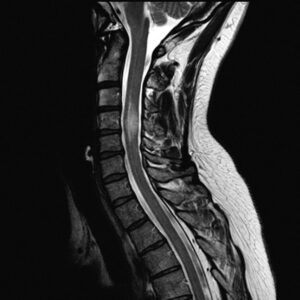

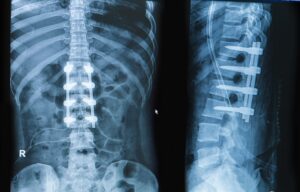







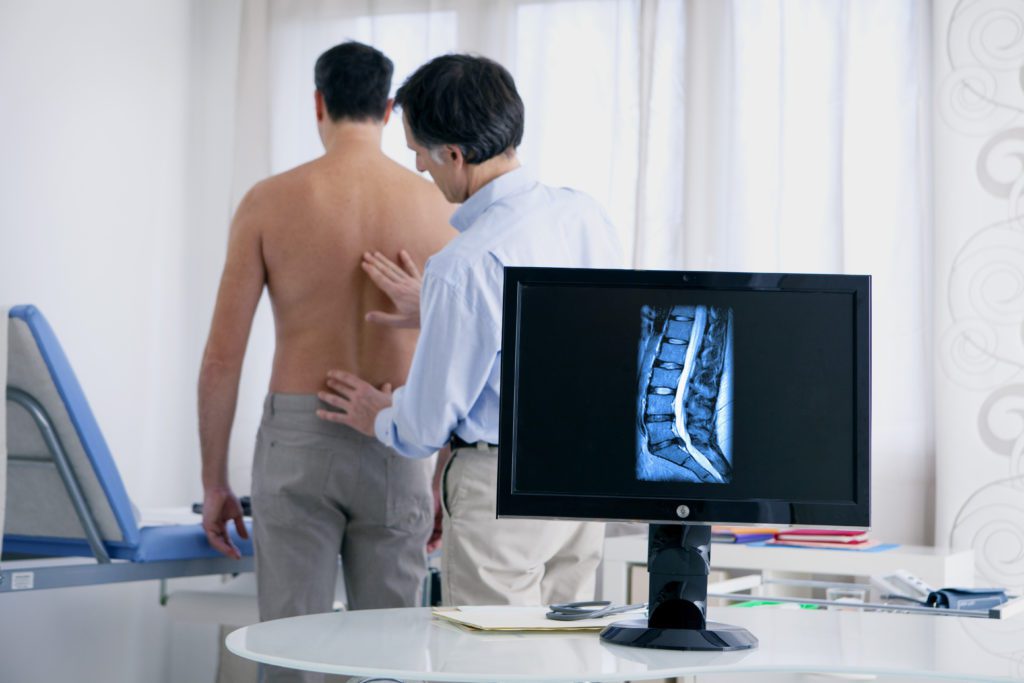
After you meet your technologist, you’ll lie down on the X-ray table to receive an anesthetic to numb an injection site along your spine followed by an injection of contrast dye. The injection typically feels like nothing more than slight pressure. If your doctor requests it, we will also collect and send a small sample of cerebrospinal fluid to a laboratory for further testing.
Your technologist may ask you to lie on your side or your stomach, and the X-ray table will be tilted at different angles. This helps the dye move through the spinal canal and makes the nerve roots and spinal cord easier to see on the scan. Next, as you lie face-down on the X-ray table, your technologist will use fluoroscopy to capture a continuous series of detailed X-ray images. Your technologist will ask you to lie as still as possible while taking the radiographs.
Your doctor may also order a CT scan to be performed immediately after the X-rays, while the dye is still in your body. The CT scan provides even more detail about soft tissues, such as root nerves, in the spinal canal.
A myelogram usually takes 30–60 minutes. A CT myelogram, using a CT scan as well as traditional X-rays, may take an extra 15–30 minutes.
One of Touchstone Medical Imaging’s radiologists will study the images taken during your myelogram and send a detailed report to your doctor, who will discuss the results with you. Your doctor will advise you about your treatment options and inform you if you need a follow-up scan to further examine any problem areas or track changes in your condition over time.
– To help make your appointment go smoothly, you should:
– Arrange for a ride to and from the imaging center.
– Discuss your current medications with your doctor. They may advise you to adjust certain medications, including blood thinners, antidepressants, and diabetes medicines.
– Stop eating for a specified number of hours before the test.
– Stay hydrated.
– Wear loose clothing that is easy to remove.
– Leave all jewelry at home.
– Please inform your care team if you have any allergies, especially to iodine or contrast materials, or if you are pregnant.
Myelograms are considered safe for most people because they use a very low amount of radiation. However, pregnant women should not receive one.
It varies person to person. Some patients experience minimal discomfort, while others find the procedure relatively painless. You will likely feel a brief sting from the numbing anesthetic and some pressure when the spinal needle is inserted. The contrast dye can cause a temporary warm or flushed feeling, a metallic taste in your mouth, or mild nausea.
Pain has a source, and understanding it is key to getting the full picture and seeking effective treatment. The team at Touchstone Imaging will do everything to help you feel comfortable throughout the test.
Full recovery usually takes about 24 hours. After the myelogram, the care team will monitor you for an hour or two before you go home. To help with your recovery, we recommend:
– Resting the remainder of the day, keeping your head slightly elevated with pillows
– Drinking plenty of water to flush the contrast material from your system
– Avoiding strenuous activity and exercise
– Avoiding alcohol and caffeine for at least 24 hours
A radiologist will carefully review your images and send a detailed report to your doctor, usually within a few days. You’ll also receive a text message to view your patient friendly radiology report.
Your doctor will then discuss the results with you, explain what they mean and advise you on the next steps for treatment and care.